
Los Angeles County Busted Records
Every busted record in Los Angeles County starts the same way. An arresting agency takes a person into detention. A booking file opens at that point. The file pulls a lot into one place. Fingerprints, identity details, and the alleged offense all sit there. So do booking and arrest times, property, bail, holds, court dates, and a photograph. What happens next depends on who made the arrest. LAPD or Long Beach Police might book someone into a city jail first. The Sheriff's Department may then move that person into county custody and issue a separate county booking number.
Don't assume everyone passes through the Inmate Reception Center. It serves as the county's main intake and classification hub. Even so, a sheriff station or municipal jail can hold a person before any transfer. A fresh arrest may be missing from the county locator for several reasons. The booking might be too new. It may still sit in city hands, or involve a citation and release. A different name spelling can hide it too. Some entries simply fall outside what the portal covers.
Busted Booking Fields Explained
The county's public custody record can still tell you plenty. A mugshot may not appear on screen. Names alone are risky. Pull the booking number. That one figure connects LASD records, any later records request, and the court file into a single thread. Then add age, arrest date, and housing location. Those extra fields help you rule out a same-name mix-up.
| Field | What it means |
|---|---|
| Name and identifiers | The identity details used for this custody record; compare age and other available data. |
| Booking number | The county reference that helps LASD locate a booking jacket and photo. |
| Arrest and booking details | The recorded times, agency, place, and circumstances at the intake stage. |
| Charge | An alleged offense entered at booking. |
| Bail and holds | Release terms or another agency’s basis for continued custody; both may change. |
| Housing | The present county location, not necessarily the arrest site or first jail. |
| Court date and location | The next listed court event and courthouse, subject to later change. |
| Release information | Movement out of that custody episode, which does not mean acquittal. |
What can agencies release? California Government Code section 7923.610 spells out arrest facts that are generally open to the public, within limits. A booking photograph is not one of the automatic fields. Material involving juveniles, sealed cases, medical details, victims, safety concerns, or active investigations may be withheld or redacted. So two questions differ here. A public booking entry is one thing. A photo you can actually obtain is another.
Why Los Angeles Mugshots Stay Offline
There's a sharp line between what LASD uses internally and what the public can search. The department runs a large Digital Mugshot System for law enforcement. It's built around fingerprint-supported identity work. That repository stays closed to the public. Faces rarely appear in the public IIC. Anyone wanting a booking photograph has to go through the controlled records route.
Keep the distinction clear. A restricted photo is not proof that no image exists. One approved picture might land in a news release while another stays locked down. Nobody should point the public toward the internal system or promise that a fee unlocks access. For practical purposes, three routes matter. The IIC covers custody facts. RIB handles an eligible photo request. The court handles disposition.
Request Los Angeles Booking Photos
Want an official Los Angeles booking photo? The route runs through LASD records channels. The LASD Record Requests page handles booking information, incarceration records, and inmate information. Keep the request narrow, since a precise inquiry is far easier to match than a broad name search. LASD posts a $16 booking-photograph fee. Paying it does not override an exemption or guarantee the photo's release.
- Gather the full name, aliases, date of birth if known, booking number, arrest or booking date, and arresting agency or station.
- State whether the request seeks the booking record, booking photograph, incarceration record, or proof-of-incarceration letter.
- Send a custody request through the official page or to cssspra@lasd.org. LASD can reroute it when another unit holds the item.
- Follow identity and notarization rules when seeking a personal incarceration letter. The mailed address for that service differs from the public counter suite.
- Use the booking number to connect any released record with the Los Angeles Superior Court case and final disposition.
Public Services Section
12440 E. Imperial Highway, Suite 120 West
Norwalk, CA 90650
(562) 345-4441; public requestors: (562) 345-4448
Monday through Thursday, 8:00 a.m. to 4:30 p.m., by appointment
Timing matters here. Under the California Public Records Act, an agency usually gets ten days to decide whether a request seeks disclosable records, and unusual circumstances allow a written extension of up to fourteen more. Those clocks measure decisions, not delivery. LASD publishes no universal production time for booking photographs.
The official request page is easier to understand in context when its interface is visible. View the LASD booking-record and photograph request route before preparing the identifying details.
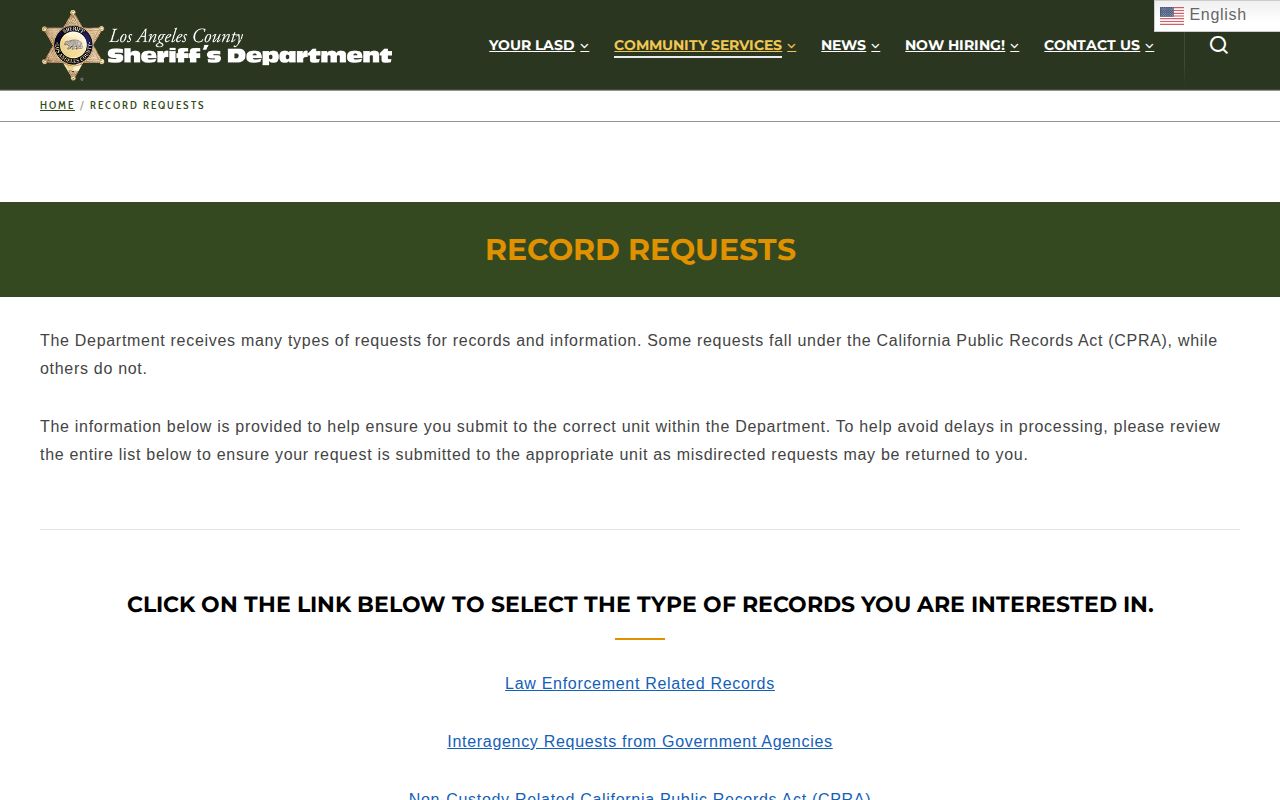
The page splits custody records from other report types, which helps a request land with the correct Los Angeles County unit.
Busted Mugshot Law and Removal
A booking photograph can live in three very different places, and California treats each one differently. Under Civil Code section 1798.91.1, no publisher may demand or accept payment from the person pictured in exchange for removing, correcting, or suppressing the photo. That is a real protection. It is not a general deletion right, though. If a site asks you for money, do not pay. Save the page address, the invoice, and every message, then talk to a lawyer or a consumer-protection agency before doing anything else.
The agency side has its own rule. Penal Code section 13665 restricts what police and sheriff departments may post about a person arrested for a nonviolent offense. A booking photo shared on department social media normally has to come down within fourteen days unless a listed exception applies. The statute carves out agency websites and electronic data systems, so it does not cover those channels. A deputy's old tweet, an inmate-locator entry, and the sheriff's internal photo file are three separate records with three separate rules.
Begin any removal or correction with whoever published the material. For an agency post, give the agency the exact URL, the post date, the person's name, and the reason a section 13665 request applies. If the arrest never led to a conviction, the California Courts sealing instructions walk through possible relief under Penal Code section 851.91 and the forms it takes. People often call a section 1203.4 dismissal an expungement, but it does not erase history. Obtain the court order first. Then mail a certified copy to every custodian who holds the item.
Commercial reposting sites are the last stop. RecentlyBooked says it charges nothing and will consider some free correction requests, though its California index did not include Los Angeles County. Busted Newspaper's Los Angeles tag mixed in bookings from other states rather than serving as a true county page. Of the major brands, Mugshots.com had the only confirmed Los Angeles County section, and its historical entries are unofficial, so verify anything there against LASD and the court. Stick to a site's current free contact channel. Once the source fixes a page, a search engine's stale-result refresh tool can clear an outdated cache or snippet.
Read the anti-pay-to-remove law itself before answering any demand for money.
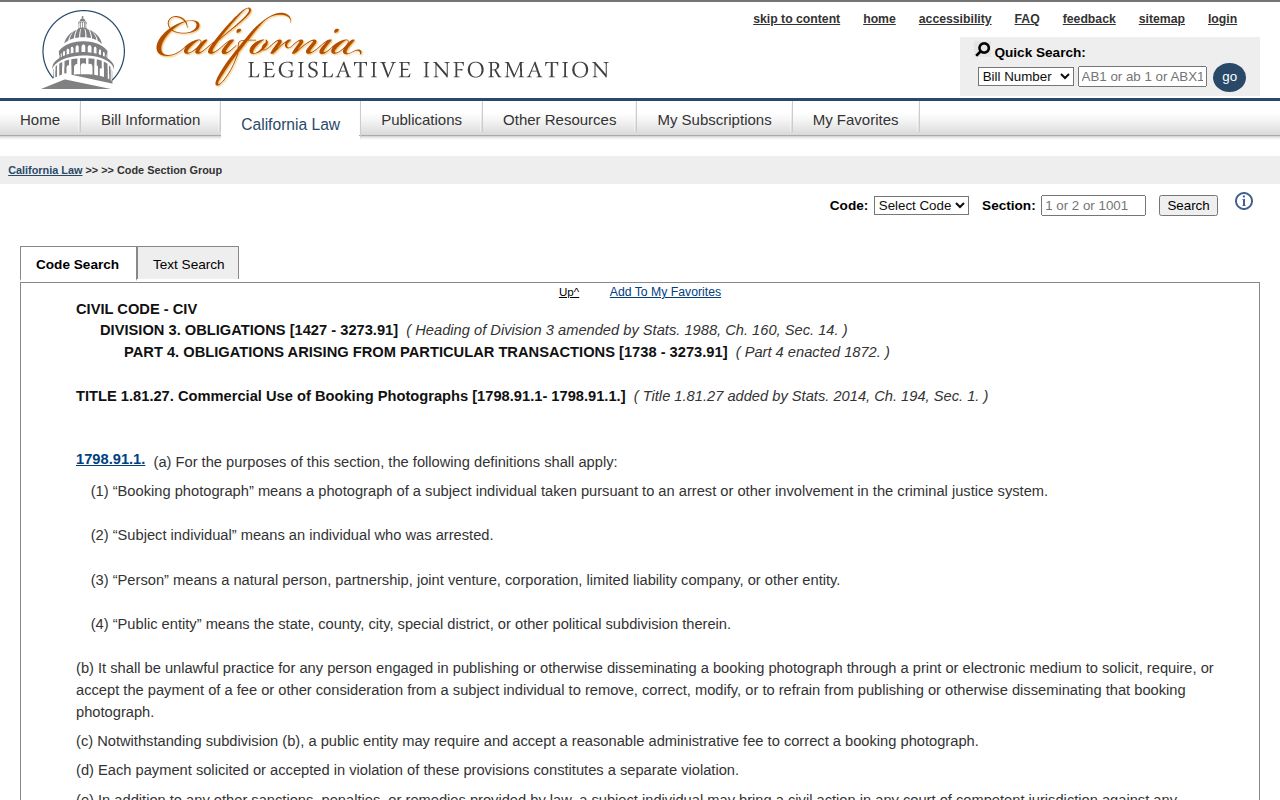
The statute goes after paid suppression only. Accuracy fixes, record sealing, and agency posting rules each run through their own channels, so match the problem to the right route.
Los Angeles Juvenile Records Stay Protected
Juvenile files are not ordinary adult booking records in Los Angeles County. Some eligible matters seal on their own. Others require a petition. A person may generally file at age eighteen, or five years after the juvenile case closed, subject to the court's rules and exclusions. The California Courts juvenile-sealing material points petitioners to form JV-595. Nobody searching for busted mugshots should be digging for a juvenile image, victim information, medical facts, or anything already sealed.
Sealing changes who can see the file. It does not guarantee every lawful government copy disappears. Read the order closely. Send it to whichever agency or publisher holds the specific copy in question. A news story or outside page may still need its own correction request.
Find Los Angeles County Busted Mugshots
Start with custody stage. Los Angeles County has no single page that covers every situation. A fresh LAPD booking leads down one branch. So does a transfer to LASD custody. A person already released, a state prisoner, and a federal detainee each lead somewhere different. Pick the branch that matches what actually happened. Then search there.
- For a person just booked by LASD, wait through the stated initial gap and search the Inmate Information Center by exact name and date of birth.
- For a station booking, check the Booking Log’s live station and date controls. Do not assume it has a fixed daily or weekly window.
- For an LAPD or Long Beach arrest, check whether the person remains in a city jail before expecting a county roster entry.
- For a released or older event, ask LASD or the city agency for the record and use Superior Court case access for the outcome.
- For a sentenced state prisoner, use CDCR CIRIS. For federal or immigration custody, use the matching BOP or ICE locator.
A third-party face page cannot settle where someone stands today. The photo may be years old. The listing may be incomplete. The match may simply be wrong. Only official agency and court records can close the question.
Los Angeles Busted Roster Search
The LASD Inmate Information Center is the county's official locator for current and recent custody. You need a first and last name to search; a middle name and date of birth help narrow things down. The site runs on reCAPTCHA. LASD warns that bookings from the prior two hours will not show up yet, and the portal does not routinely display booking photographs.
| Search field | Use | Required? |
|---|---|---|
| Last name | Enter the exact family name used at booking. | Yes |
| First name | Enter the given name and check spelling variants if needed. | Yes |
| Middle name | Helps narrow a common Los Angeles County name. | No |
| Date of birth | Helps separate people with the same name. | No |
| reCAPTCHA | Confirms a human search and blocks bulk automated access. | Yes |
Before trusting a hit, compare the booking number and the age. A result can be rich. It may include arrest details, bail, housing location, court dates and place, release data, holds, and visiting information. LASD publishes no fixed refresh schedule beyond that two-hour warning. There is also no reliable count of how long a released person's entry stays visible. Open the official Los Angeles County custody search to see its current name fields and delay notice.
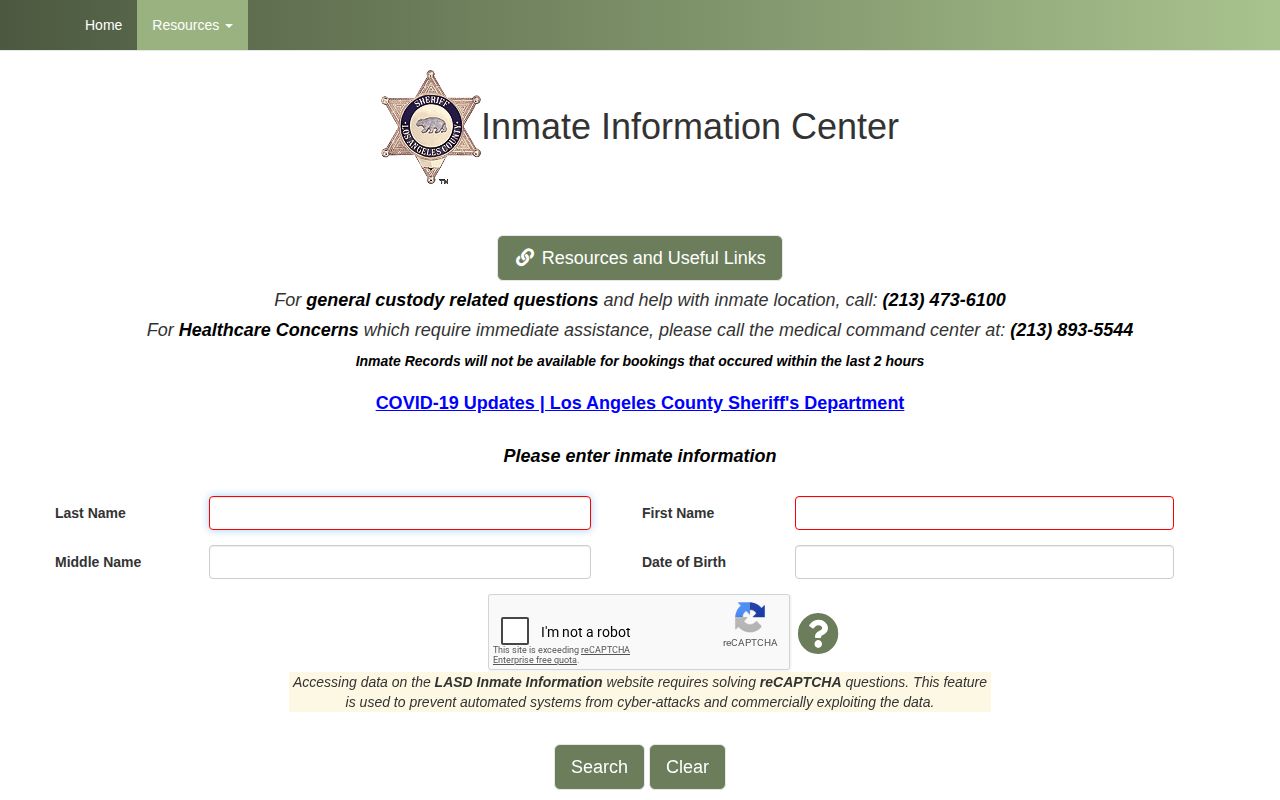
This form is a custody locator, not a photo gallery. A missing face does not mean LASD failed to take or keep a booking photograph. What if there is no match? Account for the two-hour lag, a city jail, name spelling, a citation and release, or a transfer out of county custody. Then try agency records and the court.
When Busted Records Go Live
Two Los Angeles County clocks get mixed up all the time. One governs web visibility. The other covers jail processing. The Inmate Information Center gives an exact two-hour warning before a booking first appears publicly. An IRC operations order says something different: the broader intake and classification process generally should not run past ninety-six hours. That order covers screening, classification, and housing work inside the jail system.
A record can show up in search while classification is still underway. Housing can shift after an entry appears. Neither clock promises a mugshot release, a court docket posting, or how long an entry lingers after release.
Busted Bookings Without a Fixed Feed
Start with the sheriff’s Booking Log. You can filter by station and by date, and that is about the extent of it. The department has never published a standing countywide feed of everyone booked in the last day, two days, or week. Whatever range the tool allows, you have to see it on the live screen yourself. The Custody Reports page sits nearby, but it holds briefings and statistics, not a busted roster of names and photos.
There is a slower path with firmer footing. Department policy lets a station release a daily list of arrestees straight from its gate book. You write to the station, ask for a specific date, cover the copying costs, and accept whatever redactions the law requires. Photos are not promised. A combined county archive is not either.
| Channel | Custody slice | Photo status |
|---|---|---|
| LASD IIC | Known person in current or recent county custody | No routine public photo |
| LASD Booking Log | Station and date search through live controls | No verified routine photo field |
| Station daily list | One station and one requested day | Not promised |
| LAPD open arrest data | Structured city incident and arrest data | Not a face or custody lookup |
| LBPD blotter | Selected daily city incidents | Normally photo-free |
For current filtering options, check the live Los Angeles County Booking Log instead of trusting any claimed fixed time window.
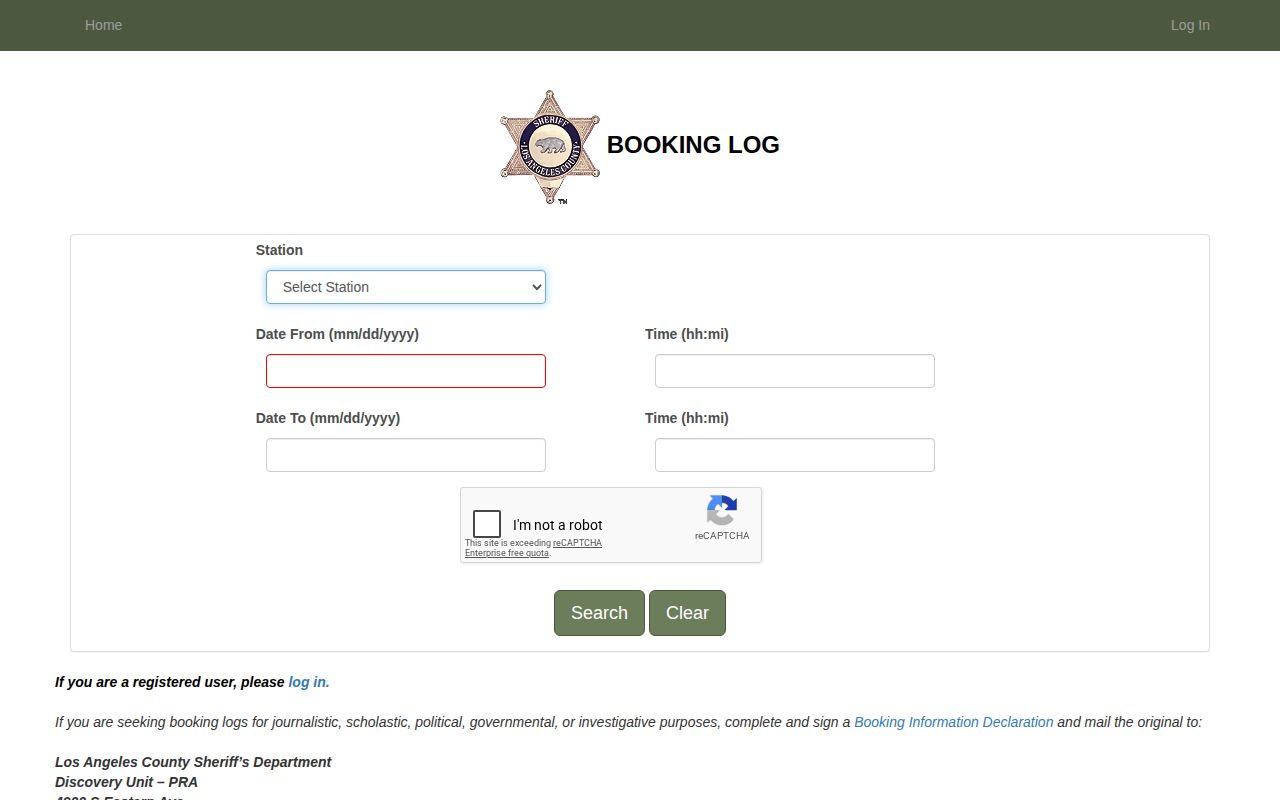
The online tool handles station-and-date lookups. The letter route fills in the dates the feed leaves out.
Note: A quiet result can reflect city custody, a citation, processing lag, or an unmatched station, not proof that no arrest occurred.
Where Los Angeles Arrest Records Move
One booking can leave footprints in several places. Read each source only for the stage it actually covers.
| Status | Best source | What it answers |
|---|---|---|
| Just booked by city police | LAPD or Long Beach city-jail channel | Whether municipal custody still holds the person |
| Held or recently held by LASD | IIC and Booking Log | County booking, housing, bail, and listed court information |
| Released from county jail | LASD records plus Superior Court | The older custody event and what prosecutors or the court did next |
| Sentenced to state prison | CDCR CIRIS | State-prison identity, location, admission, and parole-board fields |
| Federal or immigration custody | BOP or ICE locator | The matching federal custody system, not an LASD booking |
Sentenced state prisoners show up in the California Incarcerated Records and Information Search. A result there gives a name, CDCR number, age, current location, commitment counties, admission date, and parole-board details. No photograph is listed among the public fields. Keep one caution in mind: a Los Angeles commitment county does not prove the arrest happened there.
Two more locators round out the map. The Federal Bureau of Prisons tool posts no mugshot. The ICE locator tracks civil immigration detention, a separate matter from county criminal process. Neither belongs in the same pile as the LA County jail roster.
Los Angeles Booking and Release Alerts
LASD VINE sends custody alerts from the county jail system. Sign-up is free. You can register by name or booking number. Need help? Call 1-877-846-3452. One catch: if the person transfers into state prison, you must re-register with that receiving system. VINE flags custody changes only. It is not a photo feed or a separate booking record.
An older Android app called “Los Angeles County Sheriff” still links to inmate info, tips, reports, and community tools. It was last updated in 2021. It does not serve as a native photo source. Use IIC for custody status. Use VINE for change alerts. Use LA Regional Crime Stoppers for tips. Sheriff, LAPD, and Long Beach social accounts post selected cases only, never a full roster.
After Los Angeles County Booking
Penal Code section 825 sets the first deadline. A person arrested on a warrant must see a magistrate promptly, within forty-eight hours, with Sundays and holidays excluded and the statute’s session rules applied. That clock governs a court appearance. It guarantees nothing about a web docket or a booking photo appearing on the same schedule.
From there, prosecutors decide what to file. With a case number in hand, the Los Angeles Superior Court Criminal Case Access search returns a public summary, though the court notes it is not the official record itself. Document images generally stay offline. No case number? The defendant-name index, updated daily, sells a result with a case number, filing date, and location for a fee. Birth month and year no longer narrow the search, so same-name hits take patience.
Here is the sequence worth memorizing: arrest, booking and photograph, custody record, prosecutor review, arraignment, further orders, disposition. A release date marks the end of the custody episode, nothing more. Court location, case number, filing date, and the final order close out the Los Angeles County record.
Los Angeles Booking Name Conflicts
The court's defendant-name index carries its own traps. Every guest search costs $4.75. You pay even if it returns nothing, and guest results vanish after two hours. Since February 2024, birth month and year are no longer search terms. Common names collide badly when a booking number, filing date, courthouse, or case number is missing from your notes.
Work the problem in order. Pull identifiers from IIC first. Match them to a court case, then verify the key details with the courthouse itself. Treat the name index as a lead, never an official record, and expect no document images online. Depth varies by case type too. Older files may live in the Court Archives instead.
Older Los Angeles Busted Records
No fixed destruction date applies to every LASD booking jacket or photo. IIC visibility says nothing about retention, either. For an old county event, ask RIB to search by name, date of birth, booking number and date, and arresting agency. Old court papers sit with Los Angeles Superior Court Archives. They do not pass automatically to the State Archives.
The California State Archives holds a different slice of history. Its Folsom and San Quentin collections contain state-prison identification material. Some of those people were committed from Los Angeles County. Keep the distinction clear, though. Those are prison records, not sheriff's booking photos. State retention guidance can shape an inquiry, but it cannot prove the county kept to the same schedule or handed over any particular collection.
- Booking
- Intake that records identity, alleged charges, fingerprints, property, custody data, and a photograph.
- Arraignment
- The first court stage at which charges and rights are addressed.
- Bond or bail
- Terms that may permit release while the case continues.
- Disposition
- The court-stage outcome, such as dismissal, plea, acquittal, or judgment.
- Sealing
- A court process that restricts public access to an eligible record.
Busted Mugshots by Los Angeles City
Each city page tracks one of the county's three biggest cities. Each takes a different route through the system. Los Angeles leans on LAPD open arrest data and its city jails. Some people moved into LASD custody later. Long Beach runs its own jail and posts a selective daily police blotter. Santa Clarita has no police department of its own. Its arrests run through the LASD station and the county's lookup tools instead.
- Los Angeles Busted Mugshots explains the two-stage LAPD city-jail and LASD county-custody check.
- Long Beach Busted Mugshots separates the LBPD daily blotter, city jail, county transfer, and report request.
- Santa Clarita Busted Mugshots follows the sheriff-station Booking Log and IIC path.
Local news and unofficial pages may report only selected cases. The Los Angeles County crime news landscape explains how to trace a story back to its agency record and court disposition.