
Los Angeles Busted Arrest Paths
Arrests in Los Angeles do not land in one public system on day one. The city side belongs to the LAPD, which runs its own jails. The county side belongs to the Sheriff’s Department. Its jail network is far larger. LAPD bookings often rely on the county Automated Justice Information System to assign a booking number. When custody shifts to the Sheriff’s Department, the county Inmate Information Center becomes the name-based locator worth using.
Why does this two-stage path matter? A fresh arrest can be real yet invisible in county results. The person might still sit in an LAPD jail. They might have been cited and released. They might also fall inside LASD’s two-hour web delay. A differently spelled name can hide a result too. With an estimated 3,878,704 residents in 2024, same-name mix-ups are common here. Compare dates and booking identifiers before you trust a match.
Where Los Angeles Busted Mugshots Appear
Los Angeles has no official gallery of booking photos. What exists is scattered. LAPD puts out structured arrest data plus selected newsroom items. The Sheriff’s Department runs custody and booking interfaces once the county accepts a case, though its public locator rarely displays photos. News outlets pick their own cases to feature. The one confirmed commercial county archive is historical, uneven, and unofficial.
| Channel | Photo? | Status | Best use |
|---|---|---|---|
| LAPD Arrest Data | No person-photo function | Official city data | Incident and arrest patterns, not live custody |
| LAPD Newsroom | Sometimes | Official, selective | Agency releases and wanted notices |
| LASD IIC | Not routinely | Official county | Known person in current or recent county custody |
| LASD Booking Log | Not established | Official county | Station and date filters after county booking |
| Los Angeles Times, KTLA, MyNewsLA | Varies | Editorial | Selected stories, not a complete log |
| Mugshots.com county archive | Some entries | Unofficial | Historical clue only; verify upstream |
A photo in a news release can be a surveillance image, an evidence image, or an authorized booking image. Read the caption before assuming anything.
Los Angeles Arrest Data Limits
The nearest thing to a citywide booking blotter is LAPD’s Arrest Data from 2020 to Present. Treat it as a data set. It is not a daily roster of names and mugshots. It works well for incident details and broad patterns across neighborhoods and charge types. It will not tell you whether someone is still jailed. It will not say whether a case was filed, or whether a booking photo can be released. For that, you need the custody locator and the court record. The official LAPD arrest-data interface shows how the city formats this material.
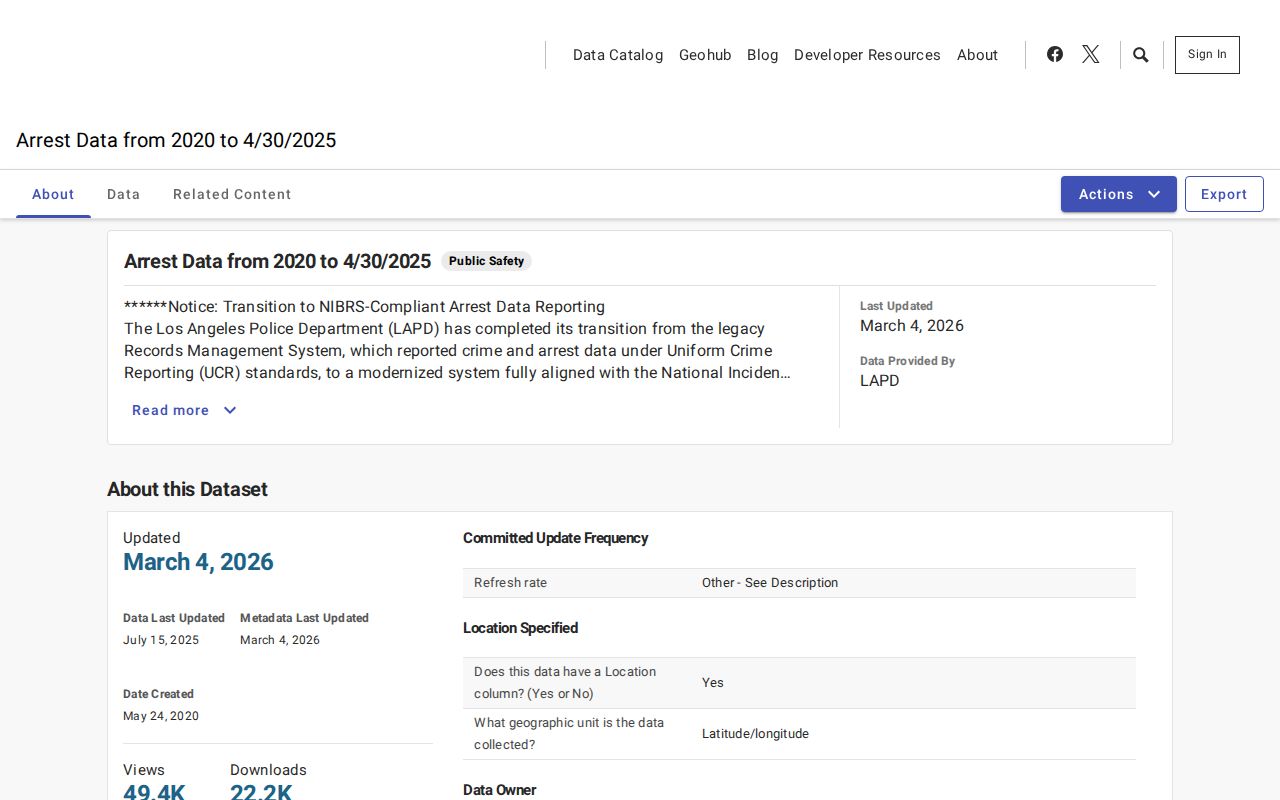
Think of the interface as a log of events, not a people finder. It tells you something happened. For a specific name, take the date and agency you see. Then follow up with the right jail and court offices directly.
Find Who Was Busted in Los Angeles
Start where custody actually begins. Skip the wide image hunt. The path below walks through the city jail, the county transfer, release, and finally the court file. One more thing it guards against: just because no photo shows up online does not mean no record exists.
- Confirm that LAPD or another city agency made the arrest and note the date, name spelling, and any report or booking number.
- For a very recent LAPD arrest, call the proper city jail or LAPD non-emergency line because the person may not yet be in county custody.
- After a possible county transfer, search LASD IIC with first and last name, then add middle name and birth date. Allow for the stated two-hour initial gap.
- Check the LASD Booking Log by its live station and date controls. Do not assume it has a fixed multi-day window.
- For a released or older record, send a focused request to the agency that holds the city report or county booking material.
- Use Los Angeles Superior Court by case number, filing place, and date to find the disposition.
Want the full county picture? The Los Angeles County busted mugshots guide maps the whole roster and records route. Keep three facts straight while you search. Current custody, an old booking, and a court outcome are each separate things.
When Los Angeles Bookings Surface
LASD offers one solid timing rule: bookings from the previous two hours will not show in IIC yet. That is a floor, not a promise. Records do not all appear at the two-hour mark on the dot. City custody adds a step. Name mix-ups or transfers can slow a match even more. Separately, LASD guidelines say intake and classification should generally stay under 96 hours. That clock covers processing and jail placement behind the scenes. It does not cover when data hits the public site.
Do not expect a guaranteed 24-, 48-, or 72-hour mugshot feed from the county Booking Log or LAPD. No fixed photo window like that was ever documented. A single city arrest can pass through an LAPD jail, county intake, a later jail placement, release, and court. Each source shows only its own slice of the journey. There is one more option. LASD policy allows stations to keep daily arrestee lists that you can request in writing. You have to contact each station for each date. Staff check the gate book for protected material first. Photos and any combined online archive are not part of the deal.
Los Angeles Busted Records Requests
LAPD and LASD each hold a different piece of the trail. City-originated material belongs to LAPD. After a transfer, county booking and incarceration details sit with LASD. To file with LAPD under the California Public Records Act, give the date, the subject, the exact record you want, and your contact information. One catch is worth knowing. The department says arrest reports are generally not released to the public and may need a subpoena or court order.
LAPD Records and Identification Division
Mail: ATTN R&I Division Document Processing Unit, P.O. Box 30158, Los Angeles, CA 90030
Office: 100 W. First Street, Los Angeles, CA 90012; public counter listed as closed
Records: (213) 486-8300, Monday–Thursday, 8:00 a.m.–5:00 p.m.
Email: WC-RI@lapd.online
Non-emergency: 877-ASK-LAPD (877-275-5273)
Want your own LAPD arrest summary? Bring fingerprints, ID, a request letter, and the $25 fee. A county booking photo goes through a different door. That one belongs to the sheriff's Records and Identification Bureau, which charges $16 when it decides release is allowed. Neither fee guarantees results. California's ten-day clock covers only the agency's decision, not the actual handover of documents.
Keep these requests separate. An arrest summary is a personal city record, and LAPD needs the fingerprints to confirm identity. A broader city request should spell out the date, the subject, and the exact record wanted. Arrest reports rarely reach the public. LAPD notes that a subpoena or court order is usually required. County custody material, such as booking details, jail records, or a controlled booking photograph after a transfer, belongs in a later LASD request. Give the sheriff full name and aliases, birth date if known, booking number, arrest date, and the arresting agency. Only the Records and Identification Bureau supplies the photo service. Copying and handling charges can stack on top. No fee unlocks a record the law holds back.
Los Angeles Busted News Photos
The LAPD newsroom posts selected arrests, investigations, wanted notices, and checkpoint announcements. Most people booked on a given day never appear there. Penal Code §13665 limits booking photos on law-enforcement social accounts too. Those images generally come down within 14 days unless an exception applies. So an old agency photo can vanish while the court file lives on.
The Los Angeles Times, KTLA, and MyNewsLA follow major city cases on their own schedules. Their pictures might come from the agency, the scene, court coverage, or file art. Always check who supplied an image and when. A commercial archive may hold an old copy. It still cannot show current custody or a final charge. The wider Crime News page explains how local reports tie back to official records.
Verify Los Angeles Arrest Outcomes
Prosecutors can reject, amend, replace, or dismiss what police book someone on. So the outcome lives elsewhere. Los Angeles Superior Court is the place to check it. Its Criminal Case Access portal works best with a case number in hand. No number? The defendant-name index returns limited identifying fields. Shared names cause mix-ups, and the guest search costs money even when nothing matches.
A release date only tells you someone left that custody episode. It says nothing about how a case ended. A state prison sentence moves a person out of the county-jail picture entirely. The California Department of Corrections and Rehabilitation search tracks those prisoners, though its public results leave out the offender photo.
For an older city case, keep the source chain straight. LAPD holds the originating incident. LASD holds the later county booking. The court holds the prosecution. The sheriff publishes no fixed retention period for booking photos and no dependable post-release display window. A tight request with full name, birth date, booking number, date, and arresting agency gives records staff their best shot at the right file.
Handle the defendant-name index with care. Updated daily, it can return a case number, defendant name, filing date, and court location when the number is unknown. A guest search runs $4.75 even with no match, and results vanish after two hours. Since February 2024, month and year of birth no longer work as search criteria. That raises the odds of grabbing the wrong case behind a common name. Match the filing date, location, and case number against the arrest record before trusting the result. Document images generally stay offline. The court itself warns its public summary is not the official record, so confirm key facts at the courthouse.
Public Record Search
Sponsored Results