
Los Angeles County Wanted Notices
Don't expect a numbered lineup. The Los Angeles County Sheriff's Department keeps no ranked roster of most wanted fugitives on its site. What it does maintain is the Information Wanted archive, a running collection of appeals tied to specific investigations. Some entries date back years. Others ask for a witness, a person of interest, or details about an event rather than someone named on a warrant. So the archive can't tell you whether a listed subject is still being sought. It certainly can't prove an unlisted person is in the clear.
LASD posts no update schedule and no countywide count for these notices. Treat each dated appeal as its own document. Read the case details and note the agency contact before anything else. The photos vary too. A posting might show a suspect, a car, evidence, or a crime scene, and those images stay on the official source rather than being copied here. Before acting on a notice, check its date. Then confirm with the investigating unit that the appeal is still live.
No Countywide Wanted Roster
Wanted information in Los Angeles County is thin by design. LASD stations, city police departments, federal agencies, and prosecutors each put out their own appeals. The Information Wanted category gathers only a slice of LASD material. It is nowhere near a complete roll of active cases. Old station PDFs that surface in search results are especially weak evidence of anything current. Start instead with the date, agency, case number, and phone number printed on the live notice itself.
That gap should not be filled by a homemade list or a grid of faces. A broad compilation risks leaving a withdrawn appeal in circulation, missing an update, or pairing the wrong person with a common name. California law also restricts how police and sheriffs post booking photos on social media. What you get is a case-by-case official record, not a stable gallery. For the current facts, call the unit named in the notice. Or check the agency's site directly.
Note: Search engines may keep an old headline alive long after the agency has changed or pulled the underlying wanted notice.
Los Angeles Wanted Listing Fields
No single form governs an LASD wanted listing. Still, an individual appeal can carry plenty of useful fields, from names and case numbers to vehicle descriptions and reward offers. Read each one in context. A blank field doesn't mean investigators lack the fact. And a reward exists only when that particular notice says so.
| Field | What it may show |
|---|---|
| Image | An authorized person, evidence, vehicle, or scene image connected to the appeal |
| Name or description | A name, alias, physical description, or identifying detail when publication is approved |
| Case narrative | The alleged conduct or the information investigators are seeking |
| Investigating unit | The LASD bureau, sheriff station, police department, or federal office handling the matter |
| Case reference | A report or file number that helps route a tip or status question |
| Reward and contact | A case-specific offer, if any, and the approved route for information |
Headlines can mislead here. A "wanted" banner usually signals a fugitive appeal, while "information wanted" may simply ask the public to identify evidence or find a witness. Read the full text before drawing conclusions. A prosecutor's later decision or a court's outcome can also diverge from what the notice describes, so the original appeal is never the final case record.
Use Los Angeles Wanted Notices
Official pages are the safest place to start, because they carry the source agency, the date, and a case contact all in one spot. Keep wanted appeals separate from custody data, though. A person can be wanted without being in custody. Once an arrest happens after publication, the relevant information moves into the jail and court systems instead.
- Open the live LASD Information Wanted archive or the police agency page named in a current release.
- Read the publication date and confirm whether the post seeks a person, a witness, evidence, or general case information.
- Record the agency, case reference, and official contact without copying or reposting the person’s image.
- If recognition is possible, keep a safe distance and send the facts through the notice’s approved contact or Crime Stoppers.
- After a reported capture, use the Los Angeles County booking and custody routes to check for a county booking, allowing for the sheriff’s initial portal delay.
An old image or a past address tells you nothing about where someone is now. Don't circulate a private guess. If the agency has pulled a post down, ask that agency directly whether the appeal remains active. The official case contact is the only reliable way to tell a live request from an archived page.
Check Los Angeles County Warrants
LASD offers no public countywide warrant portal. Its Records and Identification Bureau states flatly that it does not run warrant searches. So where does that leave you? The department's Records FAQ points anyone wondering about their own status toward a local police department or sheriff station, where staff can perform the agency check in person. That route is a different animal from scrolling through a public wanted appeal.
Anyone who suspects a warrant affects them should take a safe path to resolve it. Counsel can identify the issuing court and advise on the lawful next step. The court or responsible agency can confirm where the matter belongs. Skip the unofficial name matches. And don't go looking for ways to dodge service or arrest.
- Identify the likely arresting or investigating agency and the court tied to the case, if known.
- Contact an attorney when the warrant may concern you or when the correct court is unclear.
- Follow LASD’s official in-person route at a local police department or sheriff station for an agency warrant check.
- Use the responsible court or agency to confirm the case number, warrant status, and approved resolution instructions.
- Arrange appearance, surrender, or other compliance only through counsel, the court, or the responsible agency.
Note: A public wanted archive returning no results is not proof that no warrant exists in Los Angeles County.
Los Angeles County Warrant Types
Warrants arise at different stages. The label on one determines which office can explain the next step. An arrest warrant, a bench warrant, and a search warrant each travel its own path. Only the issuing court or responsible agency can confirm a specific record. Treat the distinctions here as general routing terms, nothing more.
| Type | Usual basis | Safe resolution route |
|---|---|---|
| Arrest warrant | A judge authorizes an arrest in connection with an alleged offense. | Confirm through counsel, the issuing court, or responsible agency. |
| Bench warrant | A court issues it after a missed appearance or failure to comply with a court order. | Contact counsel and the issuing court for appearance instructions. |
| Probation-related warrant | An alleged breach of supervision terms is presented to the court. | Use counsel, the supervising office, and the issuing court. |
| Federal warrant | A federal court or agency handles the alleged federal matter. | Contact federal counsel and the agency or court named in the official notice. |
A warrant comes from a judge. It authorizes an arrest, nothing more. The county's most-wanted archive is selective by design, so plenty of active warrants never earn a public post at all. Listings also linger: a dated wanted notice can stay indexed long after the status behind it changed. For a real answer, ask the court or the agency that issued it.
Los Angeles Wanted Tip Routes
One tip channel stands out in Los Angeles County. LA Regional Crime Stoppers keeps tip reporting apart from ordinary agency email. That matters if you want to stay unknown. The Crime Stoppers interface shows how to send information online or through its P3 option. A phone line also takes tips at (800) 222-TIPS.
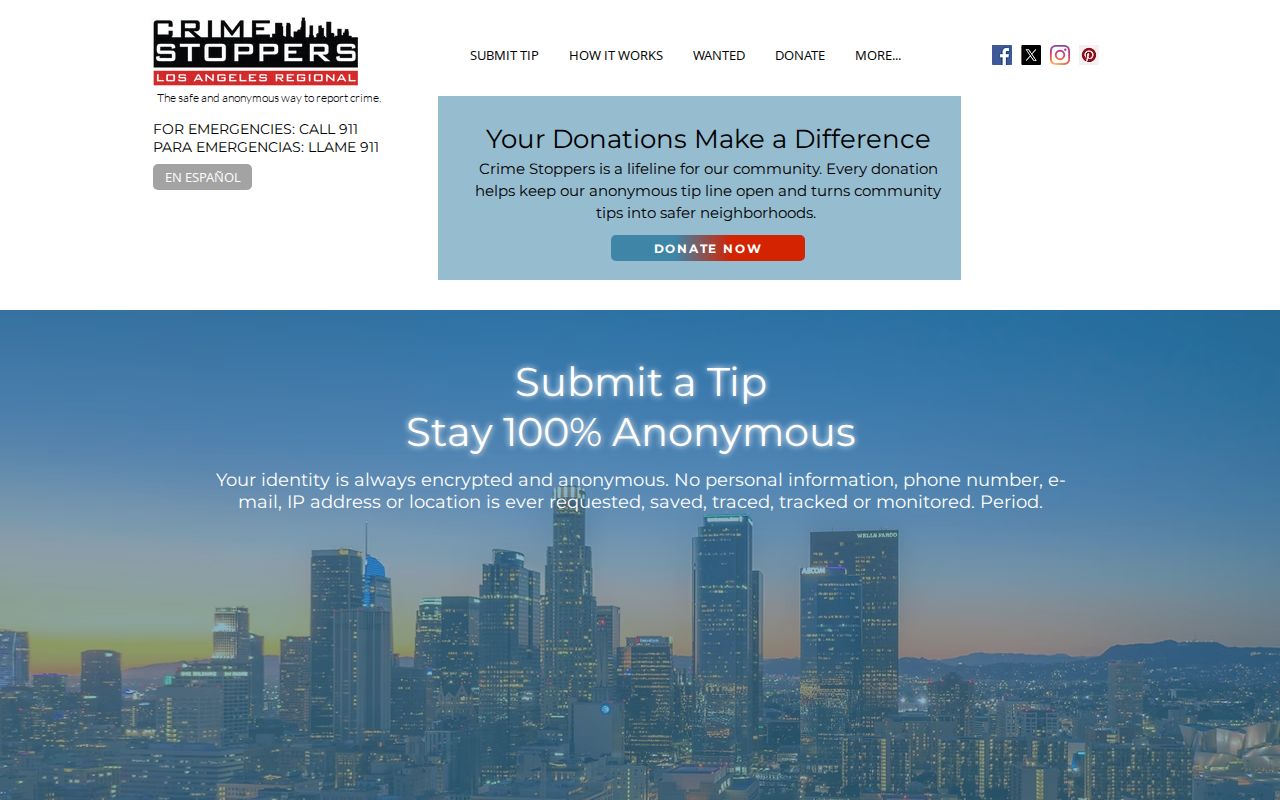
Know what the service is. It collects tips, nothing more. It is not a wanted roster or proof that any warrant exists. Stick to facts you actually know, and skip routine agency email whenever anonymity matters to you.
Anonymous tips: (800) 222-TIPS (8477)
Web and P3 Tips: lacrimestoppers.org
Rewards: offered only when the individual case notice states one
Some LASD homicide releases point elsewhere. They ask for information through the Homicide Bureau at (323) 890-5500, so use that number only when the current release for a case names it. Crime Stoppers guards anonymity through its own process. A direct call or email to an investigative unit is something different, and it should not be treated as anonymous.
Resolve Los Angeles County Warrants
Any warrant gets resolved at the court that issued it. Start there. Or go through the agency named on the notice. A defense attorney can confirm which court is involved and arrange an appearance, then advise whether turning yourself in or another court-directed step makes sense. When the case ends, the court records its outcome. That entry is called the disposition. It might show a dismissal, a conviction, an acquittal, or another resolution entirely.
Searching Los Angeles Superior Court records works best with a case number. A name alone can pull the wrong person. Plenty of people share names across the county. The official docket tells the real story of a case, not a wanted notice. Charges listed at booking can also change over time. Prosecutors may reject them, amend them, or dismiss them outright as things move forward.
Wanted Alerts and Social Limits
Two county tools get confused with warrant resources, but neither fills that role. LASD's legacy Android app bundles inmate information, reports, community resources, and a tip function. It was never built as a native most-wanted or booking-photo feed. VINE does another job entirely. It draws on county justice data to send custody and release notifications for people in the LASD jail system. Neither one substitutes for a real warrant check.
Station social accounts and agency releases run selected appeals. Even those vanish fast. California Penal Code §13665 generally forces an agency to pull a posted booking photo from social media within 14 days unless a statutory exception applies. LASD policy adds another layer, requiring authorization before units publish booking images at all. What you see on social media is brief and selective, not a lasting Los Angeles County wanted archive.
Note: Use VINE for custody alerts, Crime Stoppers for tips, and the court or agency for warrant status.