
Official Los Angeles Crime Releases
Start with the agencies themselves. The LAPD Newsroom posts frequent releases on arrests, investigations, wanted appeals, and checkpoints across the City of Los Angeles. It skips most arrests, though. Images there might show evidence, surveillance, a suspect, or an approved booking photo. In Long Beach, the LBPD Police News and daily blotter gives a steadier narrative of selected incidents, often in a morning post with updates. It omits many arrests and rarely publishes booking photos.
Santa Clarita has no city police department. Official word arrives through its LASD station and county channels instead. LASD's Information Wanted posts help on specific cases rather than serving as a broad crime wire. The FBI Los Angeles press releases handle selected federal matters. Federal prosecutors may explain charges or sentences there. None of these is a county booking feed. Each source speaks for its own jurisdiction and stage.
Los Angeles County News Outlets
News coverage in Los Angeles County runs the full range. Some outlets chase countywide breaking stories. Others stick to neighborhood court reporting. Official agency publications sit first in the table, and that placement matters. A "Photos" label there does not promise a booking photo. It only signals what might appear. The outlet may run an agency-supplied image, a scene shot, a file photo, or an authorized booking picture when news judgment and the law permit.
| Outlet | Coverage | Photos? | Where |
|---|---|---|---|
| LAPD Newsroom | Selected Los Angeles arrests, cases, wanted notices, operations | Sometimes, from official sources | Official LAPD newsroom |
| LBPD Police News | Daily or selective Long Beach incident narratives | Not routine booking photos | Official police news and blotter |
| FBI Los Angeles | Selected federal investigations and case updates | Case-dependent | Official field-office releases |
| Los Angeles Times | Major county crime and justice reporting | Agency, scene, court, and file images | California section, sometimes subscriber-limited |
| KTLA | Rolling regional breaking news | Often agency-attributed or scene images | Local News |
| MyNewsLA | High-frequency regional crime and court briefs | Mixed, often generic or supplied | Crime section |
| Long Beach Post | Long Beach breaking crime and court stories | Supplied or scene images | Crime section |
| Santa Clarita Valley Signal | Santa Clarita arrests and court developments | Station, file, or scene images | Crime section |
| SCVNews | Santa Clarita public-safety and crime reports | Event-dependent | Crime section |
The Los Angeles Times and KTLA handle all three major cities once a case carries regional weight. MyNewsLA tends to track both agency statements and what happens in court. Long Beach Post keeps its lens on the city itself. It builds stories from LBPD releases, public records, court filings, and original reporting. Up in Santa Clarita, The Signal offers the strongest editorial crime coverage. SCVNews leans toward station notices and event-driven public-safety material. None of them amounts to an all-arrests list.
Los Angeles Crime Blotters Differ
No single countywide blotter exists for Los Angeles. Long Beach comes closest. It publishes a clear daily narrative product, though it covers only selected incidents and includes a name, charge, bail, or booking destination when those details matter. LAPD takes a different path. Its open arrest data is structured. It works well for incident attributes and patterns, not for a named live-custody or face search.
Santa Clarita depends on LASD Booking Log filters, station notices, and local reporting to fill the gap. The Signal and SCVNews add narrative context. Their story choices never add up to a complete arrest record. The countywide booking and feed treatment explains why a named person may surface in LASD custody only after a city-jail or station stage. A Long Beach event can begin at the city jail. A Santa Clarita booking stays inside the sheriff system.
Note: A morning blotter, an open dataset, and a custody locator each answer a different question and belong in no single merged list.
How Photos Reach Los Angeles News
LASD holds booking photographs inside controlled law-enforcement systems. Its public Inmate Information Center rarely displays them. Records channels handle public photo requests, and news-media release requires authorization. So a police unit cannot simply drop a booking image onto its website, Nixle account, or social feed. That is why a story may carry a scene image while the matching official record shows no public face at all.
State law adds another layer. California Penal Code §13665 restricts what law enforcement may publish on social media. For a nonviolent arrest, an agency generally cannot post the booking photo unless a public-safety, judicial, or urgent exception applies. After any arrest, when a photo does go up, the law calls for removal within 14 days unless an exception continues. Agency websites and electronic data systems get different treatment under the statute. So a missing social image proves nothing about the booking or the court case.
Newsrooms have their own routes to imagery. They may receive an agency release, request records, or rely on their own scene and courtroom work. Check the credit line. "Courtesy LAPD," "LASD," or a prosecutor credit points to an official source. A file or scene caption may have no connection to a booking photograph whatsoever.
Unofficial Los Angeles Mugshot Sites
Third-party mugshot sites deserve a strong staleness warning before anything else. Among the five major booking-site brands, only one had a confirmed Los Angeles County hierarchy. The rest either skipped county coverage or slapped on a misleading Los Angeles label. Old, incomplete, or mismatched pages are common there. None can prove current custody or a final case outcome.
| Site | Los Angeles County finding | How to treat it |
|---|---|---|
| Mugshots.com | Confirmed county section with historical and uneven records | Use only as a clue, then verify LASD booking data and court disposition |
| RecentlyBooked | California index did not list Los Angeles County at verification | Do not imply a local feed exists |
| Busted Newspaper | Its Los Angeles tag mixes people associated with the city and bookings from other states | Do not present the tag as county coverage |
| Arrests.org | No genuine county section found | Do not invent or guess a local URL |
| Mugshots.zone | No genuine county section found | Recheck manually before claiming future coverage |
| SpotCrime | County daily crime archive maps incident reports | Do not call it a booking or mugshot feed |
The confirmed unofficial county section carried historical booking-style details along with some photographs. Its big displayed count was never a current booking total. Treat it as a limited archive, nothing more.
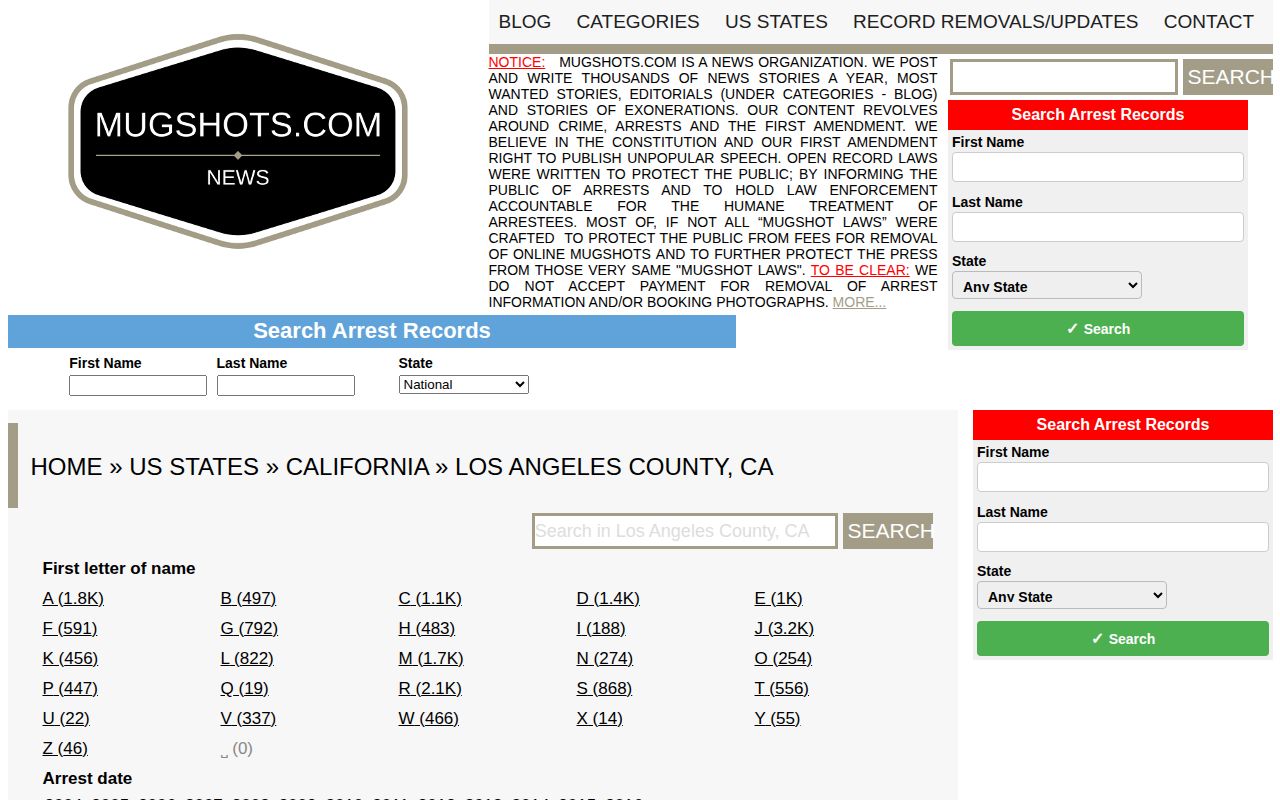
Treat any match there as a starting point. Take the booking number and date back to LASD to confirm the arrest record. Then bring that information to Los Angeles Superior Court, where the filed case and its outcome live. The screenshot simply shows the interface. It is not a gallery, and it is not an endorsement of the site.
Los Angeles Aggregator Gaps
Coverage from the big mugshot aggregators is patchy here. The RecentlyBooked California index lists no Los Angeles County section. That holds whatever its general claims about recent records might suggest. Busted Newspaper takes a different approach. Its "Los Angeles, CA" tag sorts people by an associated city and blends in bookings from other states. Arrests.org and Mugshots.zone offer no county sections worth relying on either.
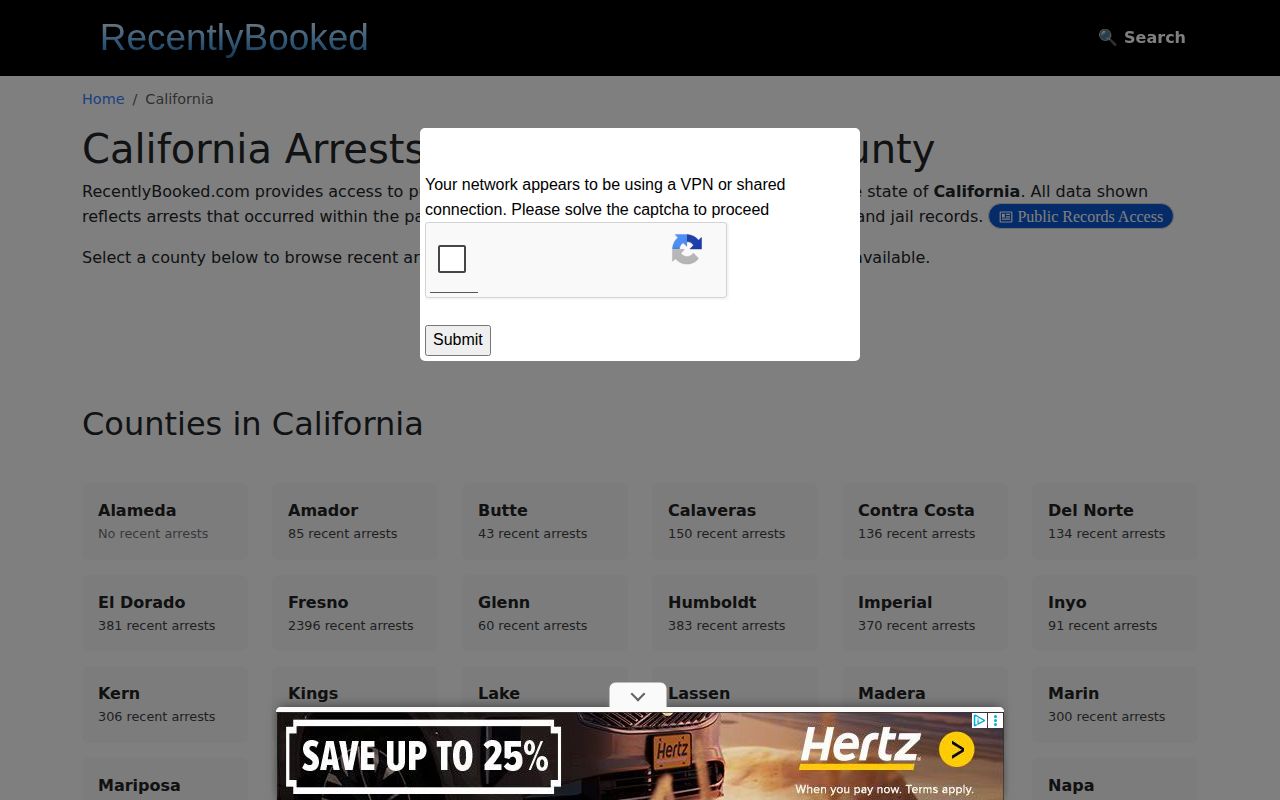
The state index backs up that absence, though it proves little else. It cannot show that a person was never booked. Aggregator coverage shifts constantly. So check the county, the source agency, the dates, and the correction policy yourself before trusting anything.
SpotCrime's Los Angeles County daily archive is a different animal. It maps incident reports rather than jail bookings or booking photos. That makes it useful for finding a reported event. It will not tell you whether an arrest happened. It will not say whether a named person entered custody. Nor will it reveal whether prosecutors filed a charge.
Trace Los Angeles Crime Stories
A news story is a lead, nothing more. The official record sits in three places: the arresting agency, the custody system, and the court. Start with what the story gives you. Pull out the name, the publication date, the incident date, the agency, and any case or booking number mentioned. Those details cut down on same-name mix-ups considerably.
- Open the agency release cited by the outlet and compare its date, location, charge, and image credit.
- For a known person in LASD custody, check the Inmate Information Center after its stated initial delay. A city jail may hold the person first.
- Use the LASD Booking Log for station and date context, but do not assume it offers a fixed multi-day window or routine photo.
- Request the booking or incarceration record from the correct city or county records unit when the person has been released or the event is older.
- Search Los Angeles Superior Court by case number when possible, then read filing status, minute entries, and final disposition.
- Return to later outlet coverage only after the agency and court checks, since corrections and case outcomes may follow the first report.
Each source answers one question. A booking record covers intake and the initial charges. The roster shows present or recent LASD custody. The court docket holds the filing and the final outcome. Once a sentence lands someone in state prison, CDCR’s search takes over, while federal cases belong to federal agencies and courts. Keeping these stages straight stops a headline from turning into a false claim about where someone is right now.
Los Angeles Court News Follow-Up
California Penal Code §825 sets the clock for court appearances. A person arrested under a warrant generally goes before a magistrate without needless delay, within 48 hours. Sundays, holidays, and the statute's session rules affect the count. That deadline governs the appearance itself. It says nothing about when an online docket or news update will show up.
What prosecutors file can change along the way. Charges first stated at booking may be rejected, amended, dismissed, or replaced. Los Angeles Superior Court's Criminal Division and its case tools carry the later filing and the recorded outcome of the case. Search by case number and court location whenever the story supplies them. Names alone invite confusion. Court document images generally are not online.
Read Los Angeles Crime News Carefully
Read every case with source, date, custody stage, and image origin in view together. An official release beats a repost, though even it records only the agency’s account at one moment. A city blotter picks and chooses. A regional story is editorial. An unofficial mugshot page may be years stale. None of them answers every question alone.
Look for posted corrections and later court coverage. For a Long Beach story, the Long Beach busted-mugshots route separates the city jail and daily police blotter from later LASD custody. Los Angeles and Santa Clarita run through different agency paths, which the city navigation lists. Never copy a booking photo into a new gallery.